


I once watched a match where a player was 2/1 to win, broke serve in the opening game, and within ninety seconds was trading at evens. Nothing fundamental had changed. One break of serve, in a best-of-three, and the price had moved as if the match was half over. That is the thing nobody tells you about live tennis betting before you start: the price is not reacting to the match, it is reacting to the maths of a single broken serve, and the maths in tennis is brutal.
Live tennis betting, sometimes called in-play or in-running, means betting on a match while it is being played, with prices that update point by point. It is not the same activity as pre-match betting with a clock running. It is a separate skill, and the people who treat it as “the same bet, just later” are the ones funding everyone else. The scoring structure of tennis creates volatility you simply do not get in a sport with a continuous clock, and learning to read that volatility is the whole game.
Why tennis was practically built for in-play betting
Take a moment to picture football for comparison. Ninety minutes, a handful of goals, long stretches where nothing decisive happens. Now picture tennis: a result reached point by point, game by game, set by set, with a clear scoreboard moment every minute or two and a natural pause between every point. If you wanted to design a sport for live betting, you would design tennis.

The numbers bear this out. Live betting now accounts for 62.35% of the entire online sports betting market, and within tennis specifically the appetite is even sharper, with point-by-point in-play betting making up more than 55% of all bets struck on the sport. That is not a niche. The majority of tennis money is now placed after the first ball is hit, and the market has reshaped itself around that reality.
The reason tennis suits in-play so well comes down to three features. First, the discrete scoring gives the market constant, well-defined moments to reprice around. Every point resolves cleanly, every game flips the server, every set is a checkpoint. Second, there is no draw and no clock to run down, so the probabilities are always live and meaningful right up to the final point. Third, the gaps between points and games give you time to think, place a bet and watch it settle in a way that a fast-flowing sport never allows.
Put those together and you get a market where the price is genuinely informative and genuinely volatile at the same time. A break of serve, a momentum swing, a medical timeout, a sudden run of double faults: each of these moves the number, often violently, and each movement is an opportunity if you understand what it should mean versus what the market has done. That gap between the fair move and the actual move is where in-play value lives.
How a live price actually moves, and why it overreacts
Here is the single most useful thing I can teach you about live tennis prices: they are driven far more by who is serving and what the score is than by who is the better player. Understand that and half the mystery disappears.
A live tennis price is essentially a probability calculator running in real time. It takes the current score, who is on serve, and a baseline estimate of each player’s strength, and spits out a win probability that becomes the odds. The crucial point is how heavily it weights the serve. Because holding serve is the default expectation in professional tennis, a single break of serve shifts the implied probability enormously, which is why that 2/1 player became evens after one break in my opening story. The model treats the break as a large chunk of the set already banked.
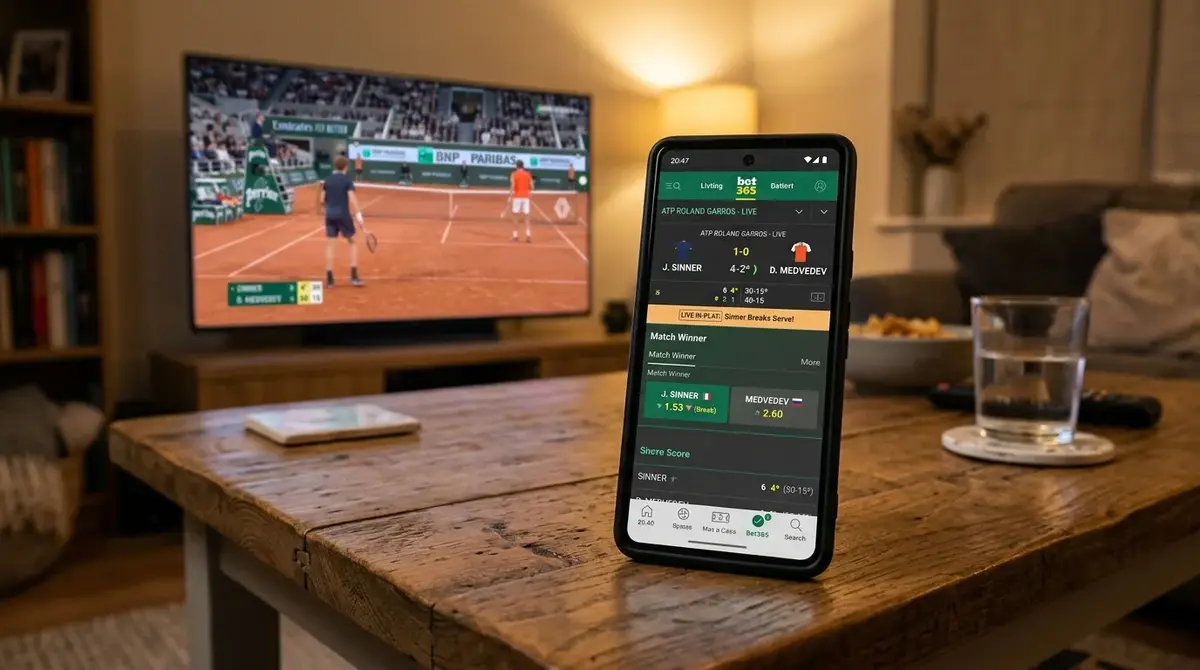
The trouble is that the model, and the crowd betting into it, frequently overreacts to the most recent point. A player saves three break points in a tense game and the price lurches as though the match has turned, when all that has actually happened is one hold of serve that was likely all along. A break against the run of play sends the number flying, even when the player who got broken is comfortably the stronger and likely to break straight back. In mature European markets, in-running turnover on the biggest football and tennis matches now routinely exceeds pre-match volume, which means a vast amount of money is chasing these swings in real time, and crowds chasing swings are exactly what create overreactions.
My approach is to form a pre-match view of how the match should go, then watch the live price for moments where it has drifted further than the situation warrants. The break that I expected and the break that surprised the market are two very different bets. When a strong favourite gets broken early and the price balloons, I am usually a buyer, because the fundamentals have not changed and the market has overpaid for one game. When the underdog I rated breaks and the price collapses, I am often a seller of that move, because I rated them precisely for moments like this. The discipline is betting the gap between fair and actual, not the excitement of the moment.
The in-play markets worth your attention
Not every live market is equal, and the menu is longer than most people realise. When the bet365 ticker or any other operator’s in-play screen lights up during a match, you are looking at a dozen ways to engage with the next few minutes, and they reward very different skills.
The live match winner is the obvious one, repricing after every point. It is where the overreaction edges I described tend to surface, because it is the most heavily traded and the most sensitive to momentum. Then there is the live set winner, narrower in scope and useful when you have a strong read on the current set rather than the whole match. Live game markets let you bet on the outcome of the very next game, which is almost a pure read on whether the server will hold, and they are surprisingly tradeable if you understand serve dominance.
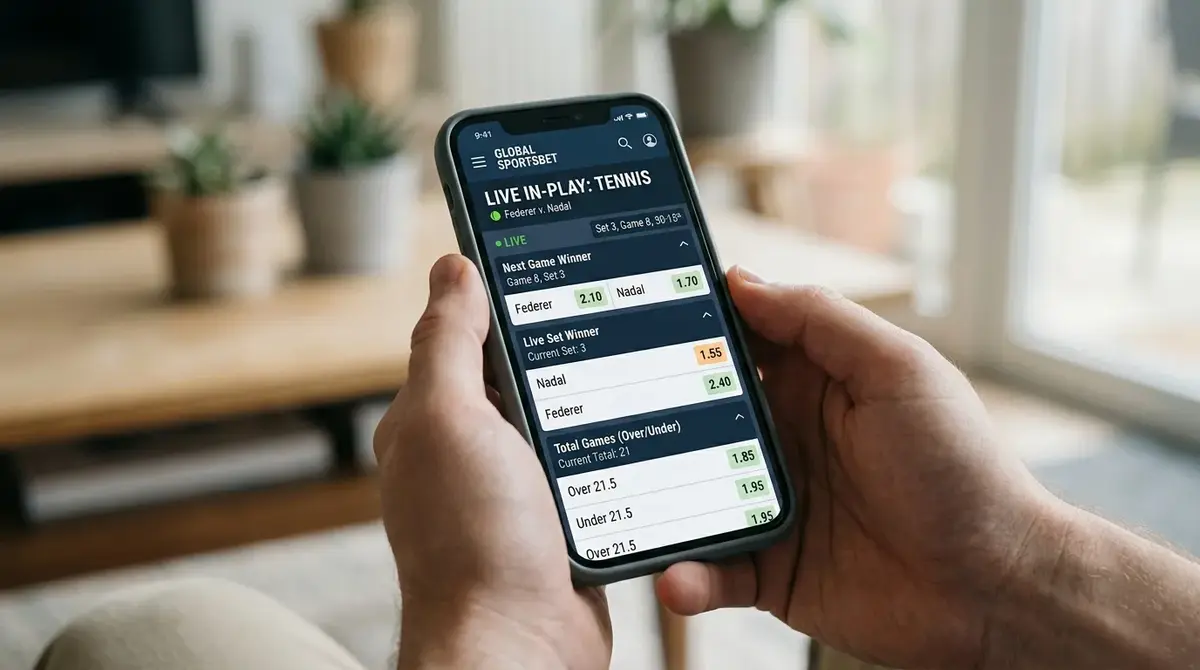
Beyond the result markets sit the in-running totals. The live over/under on total games keeps updating as the match progresses and the picture clarifies, and I find it one of the more reliable in-play plays because a games line responds to break frequency, which becomes easier to judge once you have watched a set or two. Live handicaps work the same way, letting you back a player to cover a set or game line with the benefit of having seen how the match is actually unfolding rather than guessing pre-match.
There are also the moment-to-moment props: next game winner, will there be a tiebreak in this set, race to a number of games. These are short-fuse bets that resolve fast and suit a bettor who wants frequent action with small stakes. My honest advice for someone starting out is to ignore most of the prop menu and concentrate on the live games total and the live match winner. Those two markets teach you to read momentum and serve dynamics, which is the foundation everything else is built on. Spread yourself across every market on the screen and you will learn none of them properly.
Reading momentum without falling in love with it
Momentum is the most overused word in tennis commentary and the most misunderstood concept in live betting. Punters treat it like a physical force that, once moving, must keep moving. The market often does the same. Learning when momentum is real and when it is a story the crowd is telling itself is, in my experience, the single biggest edge in the in-play game.
Real momentum in tennis is usually mechanical rather than mystical. A player who has found their first serve, started returning deeper, or solved a tactical problem is genuinely playing better, and that tends to persist. A player who broke serve because their opponent threw in three loose double faults has not generated anything durable; they have benefited from a blip that is likely to correct. The market frequently cannot tell the difference in the moment, and that confusion is your opportunity. When the price swings hard on a momentum story that has no mechanical basis, the swing is usually a fade.
This is where the relentless nature of the sport works in your favour as an analyst. As the ITIA’s intelligence director Nick Iliffe has put it, tennis is a global sport with no real off-season, which means there is always live tennis to watch and a deep, constant stream of matches to learn momentum patterns from. The more matches you watch with this lens, the better you get at separating the genuine shift from the noise, and there is never a shortage of material to practise on.

I keep two questions running whenever the momentum narrative kicks in. Is the player who just gained an advantage actually doing something repeatable, or did they get gifted it? And has the price moved more than that change in reality justifies? If the advantage is real and the price has barely moved, I am interested in following it. If the advantage is flimsy and the price has lurched, I am interested in opposing it. The crowd bets the story. The patient bettor bets the gap between the story and the scoreboard.
There is also a hidden hazard worth naming, and it catches almost everyone at first: latency. The picture you are watching on a stream is usually several seconds behind the live court, and the prices update on the real point, not the one you are seeing. Bet on what looks like a fresh momentum shift on your screen and you may be betting into a market that has already absorbed the next two points and repriced accordingly. The people who trade in-play seriously work off the fastest data they can get and never trust a delayed broadcast to time their entries. For a casual bettor the lesson is humility: assume the market knows something you do not yet, and do not chase a price that has already moved before your eyes caught up.
Live versus pre-match, two different jobs
People ask me whether they should bet a match before it starts or wait and bet it live, as though one is simply better than the other. They are not competing options. They are different jobs that suit different reads, and the best bettors use both deliberately.
Pre-match betting rewards research done in calm conditions. You have time to study form, surface, head-to-head and conditions, build a considered view and place a bet at a price that reflects the full information available before a ball is struck. The downside is that you are committing before you have seen a single point, and tennis matches can look nothing like the form guide from the very first game. Live betting flips that entirely. You sacrifice the calm and the time, but you gain information: how each player is actually moving, serving and competing today, which the form guide can never tell you.
The events that suit live betting most are the long ones, and nothing is longer than a Grand Slam. A Slam delivers a continuous stream of in-play markets across fourteen straight days, with matches running back to back from morning to night, which keeps liquidity deep and gives a live bettor an enormous volume of repricing moments to work with. That depth of liquidity matters, because thin live markets move erratically and limit your stakes, whereas a flagship Slam match will absorb meaningful money without distorting.

My own habit is to use pre-match for the bets where my research gives me a clear, stable edge, and live for the bets where I want to see how the match develops before committing, or where I expect the market to overreact to early swings. The two complement each other. A pre-match position can be supported, hedged or doubled live once the picture clarifies. Treating them as a single toolkit rather than rival approaches is what separates a complete bettor from a one-trick one.
The tools the apps give you, and what they really cost
Modern betting apps hand you a suitcase of in-play tools, and every one of them is designed to feel like it is on your side. Auto-bet, one-tap staking, partial settlement, the lot. The most prominent of them all is cash out, and understanding what it really is matters more than any other tool decision you will make live.
Cash out lets you settle a bet before the match finishes, taking a price the bookmaker offers based on the current state of play. When your selection is winning, the cash-out figure shows a profit you can lock in; when it is losing, it shows a reduced loss you can take to escape. It feels like a safety hatch, a way to bank a sure thing or limit the damage, and that feeling is exactly why it is so widely used. The reality is less comforting. A cash-out offer is a brand-new bet at a price the operator sets, with its own margin built in, not a neutral reflection of the true odds.
That does not make cash out useless, but it does mean you should treat it as a decision rather than a reflex. Sometimes locking in value genuinely is the right call, particularly when a match has swung your way and you do not fancy the volatility of seeing it through. Other times you are simply handing the bookmaker an extra slice of margin to soothe your nerves. Because the maths matters so much here, I have written a full breakdown of when the function helps and when it quietly leaks value in the guide to cash out tennis betting, and I would read it before you start tapping that button mid-match.
The broader point about live tools is that none of them are neutral. They exist to keep you engaged and trading, because the more you bet in-play the more margin you pay. Use them with your eyes open. A tool that helps you execute a plan is an asset; a tool that talks you out of a good bet or into a bad one because it feels safe is a liability dressed up as a feature.
Staying disciplined when the match is moving fast
The dangerous thing about live tennis betting is the same thing that makes it appealing: the speed. A pre-match bet gives you time to reconsider. A live market gives you a few seconds between points, an adrenaline spike when the score swings, and a one-tap button to act on the urge. That combination is engineered to bypass your judgement, and the bettors who lose at in-play almost always lose to their own impulses rather than to the bookmaker’s edge.
The first discipline is pre-deciding your triggers. Before the match starts, I know roughly what I am looking for: a strong favourite drifting after an early break, an over-priced momentum swing to fade, a games line I want to attack once I have seen the serving patterns. When that trigger appears, I act. When the screen is just flashing prices and nothing on my list has happened, I do nothing, however twitchy that feels. The market will offer a hundred bets in a single match and maybe two of them are yours.
The second discipline is stake control under pressure. It is dangerously easy to chase a live position that has gone wrong by betting again, bigger, on the next point, because the next point is always thirty seconds away. That is how a small in-play loss becomes a session-wrecking one. I size live bets the same way I size pre-match bets, set a hard limit on how much I will commit to a single match in-play, and stop when I hit it regardless of how the match is going.

The last discipline is knowing when to close the app. Live tennis is relentless by design, and the constant availability of action is precisely what makes it easy to overdo. If you find yourself betting because there is a match on rather than because there is a bet worth making, that is the signal to walk away. The skill in live betting is not reacting to everything. It is reacting to the few moments that matter and ignoring the rest, and the patience to ignore the rest is the rarest and most valuable habit a live bettor can build.
Articles
Created by the "bets-on-tennis.com" editorial team.
