


Serve-prop markets are where I send people who keep losing on match winner bets, because they force you to stop thinking about who wins and start thinking about how the match is actually played. An ace line does not care who lifts the trophy. It cares about racket-head speed, ball toss, surface friction and the return position of the man or woman on the other side of the net. That shift in focus is liberating once you embrace it.
Aces and double faults markets ask you to bet on the count of a specific serving event, usually over or under a line, either for a single player or for the match total. An ace is an unreturnable serve that the opponent fails to touch; a double fault is two missed serves on the same point, conceding it outright. These are some of the purest markets in tennis, because they detach almost completely from the result. You can profit from an ace bet on a player who loses, and that independence is exactly why I rate them.
How an Ace Line Comes Together
The first time I dug into how bookmakers set ace lines, I expected something crude. What I found was a tight, data-rich model built almost entirely from each player’s serving history on the relevant surface. The favourite’s quality barely features. What matters is how big the server is, how the surface behaves, and how well the returner reads a serve.

The line is essentially a projection of expected aces given the matchup. A genuine bomber who routinely fires twenty aces a match against an average returner on a quick court will carry a high line. A flat, placement-first server against an elite returner on a slow court will carry a low one. The bookmaker blends the server’s recent ace rate, the opponent’s return ability and the surface speed into a single number, then prices over and under around it with their margin baked in.

The reason these lines are so sharp is the sheer volume of granular data now flowing through tennis. Point-by-point live bets make up over 55% of all wagers on the sport, which means firms track serving events in extraordinary detail, match after match, season after season. They know each player’s ace distribution, not just their average, which lets them set lines that are genuinely hard to beat with surface-level reasoning. You need a specific, informed angle, not a vague sense that someone “serves big.”
Why Surface and Serve Style Decide Everything
Here is a question that separates the serious serve-prop bettor from the dabbler: would you back the same player over the same ace line at Roland-Garros and at a fast indoor event? If your answer is the same in both cases, you are missing the entire point of the market.
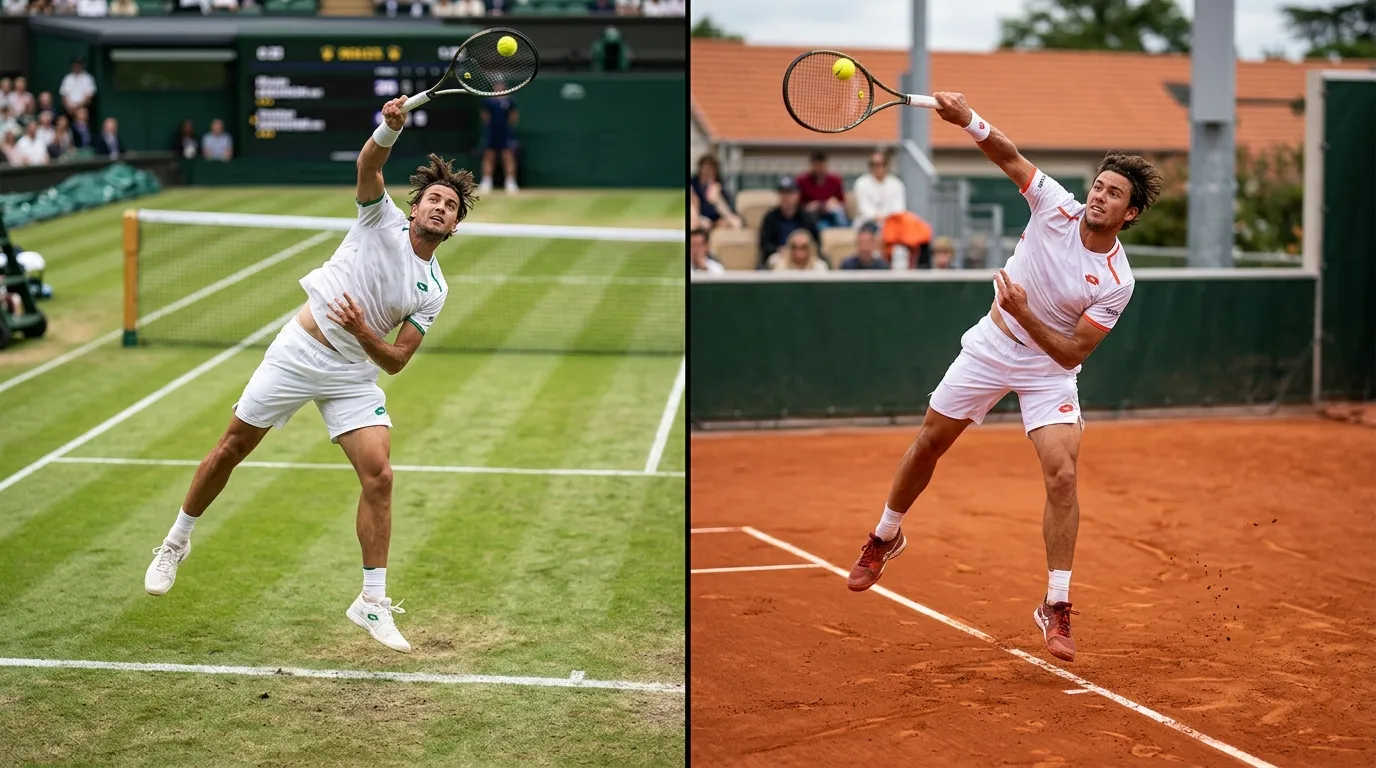
Surface is the master variable for serving. A fast, low-bouncing court gives the server less time to be read and rewards raw pace, so ace counts climb. A slow, high-bouncing surface lets the returner step in, take the serve later and get a racket on balls that would be winners elsewhere, so ace counts fall. The very same player, with the very same serve, will produce markedly different ace numbers across the calendar simply because the courts change underneath them.
Serve style layers on top of surface. A player who lives on first-serve power is feast-or-famine: huge ace counts when the serve fires, sharp drops when it misfires, which makes their over and under lines volatile and occasionally exploitable. A player who relies on spin, placement and a high first-serve percentage generates fewer outright aces but more consistent numbers, which makes their lines steadier and harder to attack. The tennis betting segment was worth around 16.53 billion dollars in 2025, roughly a tenth of the whole sports betting market, and serve props are a small but growing corner of that, sharp enough that the edge comes from knowing a specific player’s surface tendencies better than the model does, not from broad assumptions about who serves hard.
The Quieter, Trickier World of Double Faults
Double-fault markets are the neglected cousin of the ace market, and I treat them with real caution. A double fault is not a skill you bet on, it is a mistake you bet on, and betting on mistakes is inherently noisier than betting on a player’s strengths.

The appeal is that some players are chronically prone to double faults under pressure, especially second-serve-shaky players in tight moments, and those tendencies do persist. A nervy server in a high-stakes match, or one whose second serve has been a known liability all season, can be a reasonable over candidate. The numbers are smaller than ace counts, so the lines are tight and a single extra fault can swing a bet, which cuts both ways.
What makes me wary is the volatility. Double faults cluster unpredictably, driven by nerves, wind, momentum and the score, none of which model cleanly. A player can sail through a match faultless and then spray three in a single tense service game. Because the lines are low and the events are erratic, the variance is high relative to the stake. I bet double faults only when I have a strong, specific read on a player’s second-serve fragility against a particular opponent or in a particular pressure context, never as a routine play.
Finding a Genuine Edge in Serve Props
The edge in serve-prop markets is almost always informational, and it comes from knowing one specific thing the line has not fully captured. The most reliable angle I have found is the surface transition. When a big server moves from a slow surface to a fast one, or vice versa, the market sometimes lags their true ace ceiling on the new court, anchoring to their recent slow-court numbers. That lag is where I look first.

The second angle is the matchup-specific return read. An ace line is set partly on the opponent’s return ability, but return quality is surface-dependent too. A returner who is elite on clay can be merely ordinary on grass, and if the line treats them as a strong returner regardless of surface, the server’s over may be underpriced on the faster court. These are narrow edges, but serve props are a narrow market, and narrow is where the inattention of the crowd leaves room.

Serve props also interact closely with another in-match market, because matches stuffed with holds of serve and few breaks tend to drift toward tie-breaks. If you are reading a match through its serving patterns, you are halfway to reading its tie-break probability too, and the two markets often reward the same underlying view. I lay out how that probability is priced in my piece on tennis tiebreak betting, and reading the two together has sharpened my serve-prop bets more than any single statistic. The serve is the thread that runs through both.
Articles
Prepared by the bets-on-tennis.com editorial staff.
