


Whenever someone asks me which is the best tennis betting site in the UK, I answer with a question of their own: best for what? It sounds like a dodge, but it is the only honest reply. The best tennis betting sites for a Wimbledon outright punter look nothing like the best ones for a live in-play trader or someone who only bets the men’s Slams. There is no single winner, and any article that hands you a ranked list of operators with a number-one slot is selling you something, usually a sign-up link, not advice.
So this is not a leaderboard. It is a framework for judging a tennis betting site against what you actually do, so you can work out which one fits you rather than which one a marketing budget pushed to the top of a page. I will walk through the criteria that genuinely matter for tennis specifically, explain how UK licensing protects you, and show you how to compare sites without being seduced by a headline offer.
The reason this matters is that the differences between operators are real and they cost you money. Two sites can price the same match noticeably differently, cover wildly different ranges of markets, and treat your account in ways that range from generous to hostile. Choosing well is not about chasing the biggest welcome bonus. It is about finding the place that prices your bets fairly, covers the tennis you bet on, and treats you like a customer worth keeping.
What actually makes a betting site good for tennis
Forget the adverts for a second. A betting site is, at its core, a shop selling you prices, and a good shop sells you better prices on the things you buy. For tennis, that means a handful of specific qualities, and the flashy stuff the marketing leads with rarely appears on the list.
The first quality is competitive odds, because price is the only thing that compounds. A site that consistently offers a fraction better on tennis match winners and totals will, over hundreds of bets, leave you meaningfully better off than one with a slightly worse line and a bigger bonus. The second is depth of markets. Some operators offer little more than match winner and set betting on lower-profile matches, while others price handicaps, totals, props and live markets across the full tour calendar. If you bet beyond the headline market, that depth is the difference between having a bet and watching one.
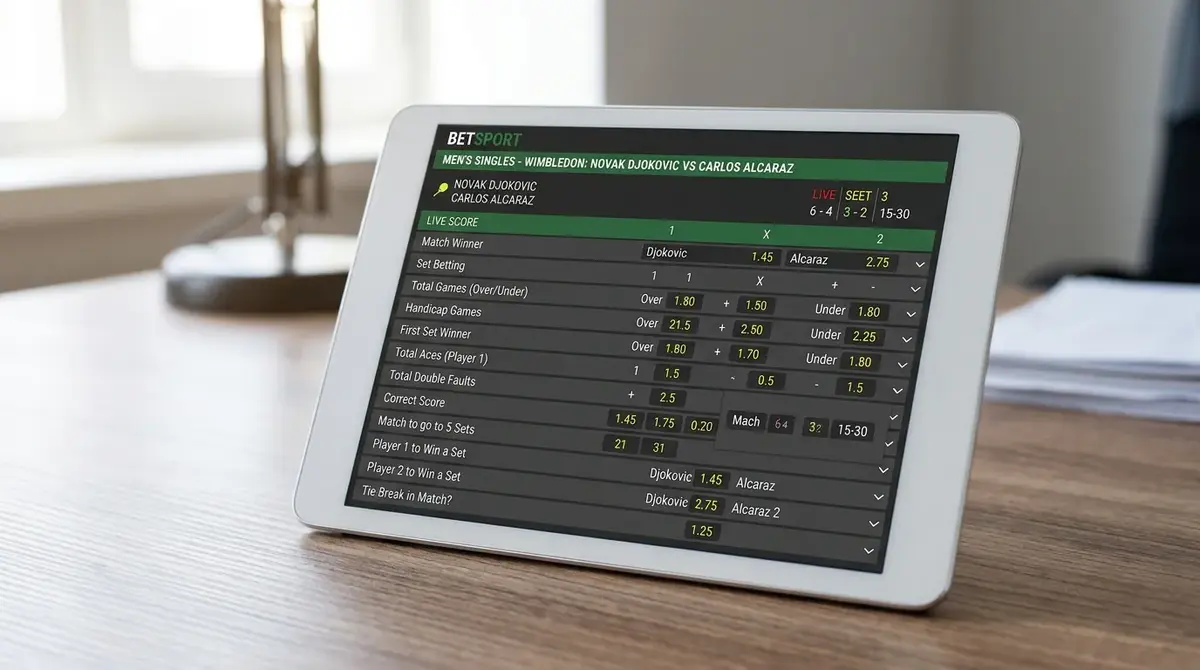
The third quality, and the one most people overlook until it bites them, is how the site treats winning customers. Some operators welcome consistent winners; others restrict or close accounts that show a profit, limiting your stakes to a few pounds. This is legal and common, but it varies enormously between operators, and a site that limits you the moment you show skill is useless to a serious bettor regardless of how good its app looks. The scale of the UK market gives operators plenty of customers to be choosy about: across a year, British punters placed some 26.1 billion bets and spins, with roughly 12 million active accounts in a typical month, so an operator that does not want your winning action has no shortage of casual replacements.
Beyond those three, the practical stuff matters: a fast, stable app that does not crash when a match swings and prices freeze; clear and fair rules on how bets settle, particularly the retirement and walkover rules that bite so often in tennis; and responsive support when something goes wrong. None of this is glamorous, and none of it features in a welcome offer, which is precisely why it is the stuff worth weighing. A good tennis bookmaker is a good shop, not a good advert.
There is a quieter signal I have learned to watch for over the years: how a site prices the unglamorous matches. Any operator will offer a tight, competitive line on a Wimbledon final, because everyone is watching and the volume of money keeps it honest. The real tell is a routine first-round match between two players ranked outside the top fifty on a wet Tuesday afternoon. A site that still prices that match keenly, with a sensible margin and a decent spread of markets, is one that takes tennis seriously across the whole calendar. A site that quotes a lazy, wide price on it is quietly telling you exactly how it will treat the bulk of your betting for the eleven months of the year that are not a Slam.
Licensing and safety, the non-negotiable first filter
Before any of the criteria above matter, one thing has to be true: the site must hold a licence from the UK Gambling Commission. This is not a nice-to-have. It is the single hard filter that everything else passes through, and getting it wrong can cost you not just an edge but your entire balance.
A UKGC licence means the operator is bound by British rules on how it holds your money, how it must treat you fairly, how it handles complaints, and what safer-gambling protections it has to provide. Your funds are protected to a stated standard, disputes have a route to independent resolution, and the operator answers to a regulator that can and does fine and strip licences. The UK gambling industry is enormous and tightly watched, generating around 4.5 billion pounds in gross gambling yield in a single recent quarter, and that scale is matched by a regulatory regime that gives licensed-site customers genuine recourse. An unlicensed site offers none of this. If it refuses to pay you, there is no British regulator to appeal to and your money is effectively gone.
Checking a licence is straightforward and takes a minute. Every legitimate operator displays its licence details, usually in the footer, and you can verify them against the Gambling Commission’s public register. If a site is reluctant to show a licence, displays one from an offshore jurisdiction you do not recognise, or aggressively markets to UK customers without UKGC authorisation, treat that as a flashing red light and walk away. The cheaper odds or fatter bonus a grey-market site dangles are never worth the risk of having no protection at all.

Licensing also brings the safer-gambling architecture that I regard as a feature, not a restriction. Deposit limits, time-outs, reality checks and self-exclusion are all mandated for UK-licensed operators, and they exist to keep your betting within bounds you set yourself. I treat these tools as standard equipment for any bettor, not as something reserved for people in trouble, and I have written a full guide to the responsible gambling tools UK operators are required to offer. Setting them up on day one, before a losing run tempts you to chase, is one of the smartest habits a new bettor can build.
Exchanges versus sportsbooks, two different machines
The first time I used a betting exchange instead of a traditional sportsbook, it felt like switching from a corner shop to a wholesale market. The mechanics were unfamiliar and a bit intimidating, and then the prices made me wonder why I had spent years paying retail. Understanding the difference between the two models is one of the more valuable things a tennis bettor can learn, because they suit different needs.
A traditional sportsbook sets the odds and you bet against the house. The operator builds a margin into every price, profits when its book is balanced in its favour, and may restrict you if you win too consistently. It is simple, familiar and convenient, and for most casual bettors it is perfectly fine. An exchange works differently. It is a marketplace where you bet against other customers rather than the house, with the operator taking a commission on your net winnings instead of baking a margin into the odds. The best-known example in the UK is Betfair, which pioneered the exchange model. Because you are trading with other bettors, the prices are often sharper, and crucially you can lay, which means betting on an outcome not to happen, something a sportsbook will not let you do.
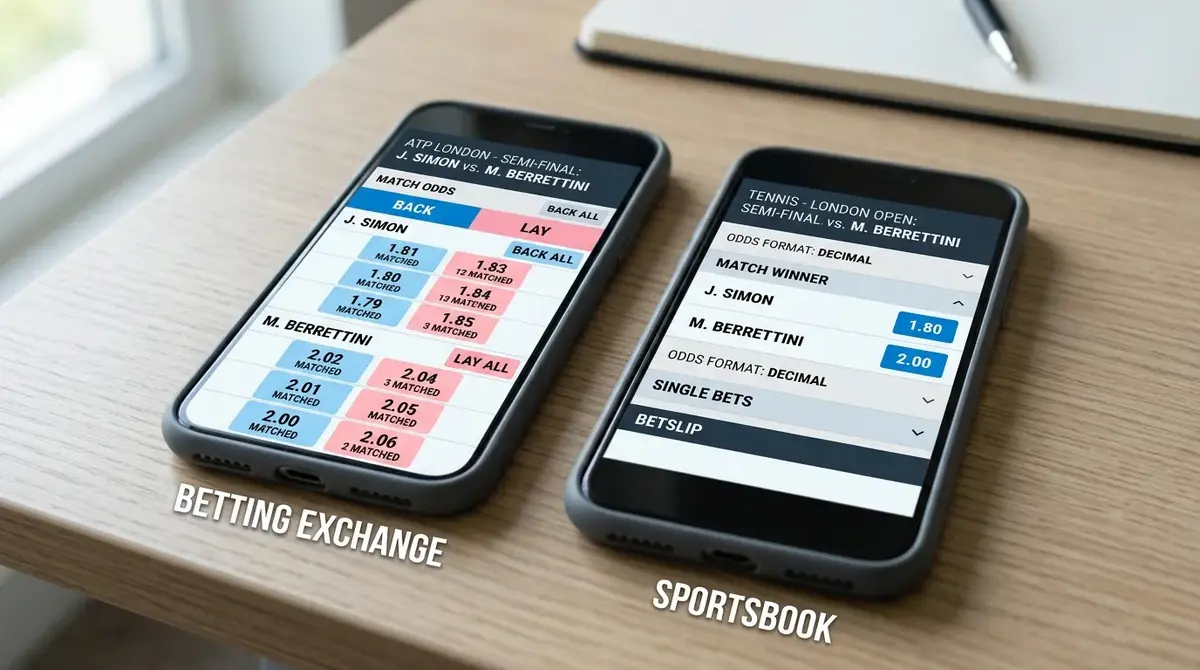
For tennis, the exchange model has real advantages. The ability to lay lets you bet against a player or a scoreline, hedge an existing position, or trade in and out of a match as the price moves, which suits the volatile, point-by-point nature of live tennis perfectly. Exchanges also tend not to restrict winning bettors the way sportsbooks do, since they make money on commission regardless of whether you win, which matters enormously if you intend to take this seriously.
The trade-offs are liquidity and complexity. An exchange only works if there is enough money on the other side of your bet, so it is excellent on big matches and patchy on obscure ones where a sportsbook will still quote a price. The interface and the concept of laying take some getting used to. My honest take is that a serious tennis bettor benefits from having access to both: a sportsbook for convenience and for markets the exchange does not cover well, and an exchange for sharp prices, laying and freedom from restriction on the matches that carry liquidity.
A word of caution on exchanges, since I have fallen into this trap myself: commission eats into your returns in a way that is easy to forget when you are admiring the sharper prices. The headline rate looks small, but it applies to your net winnings on every market and it compounds across a busy month. Factor it into your value calculation rather than treating the displayed odds as the whole story. Even after commission an exchange usually beats a sportsbook on price for tennis, but the gap is narrower than the raw numbers suggest, and pretending the commission does not exist is how you talk yourself into bets that are not quite as good as they first appear.
Markets and coverage, does the site bet your tennis
I once spent a frustrating evening trying to bet on a Challenger-level match that I had researched thoroughly, only to find that my main account did not price it at all beyond a bare match winner with stingy odds. The lesson stuck. A site is only as useful as its coverage of the tennis you actually bet, and coverage varies far more than the headline branding suggests.
Coverage has two dimensions: breadth and depth. Breadth is how much of the calendar a site prices, from the Grand Slams down through the ATP and WTA tours to the Challengers, ITF events and the women’s lower tiers. An operator that only takes serious bets on the marquee tournaments is fine for a casual Slam punter and useless for someone who bets the wider tour. Depth is how many markets it offers on each match, from the basic match winner and set betting through to handicaps, totals, props and a rich live menu. A site can have broad coverage but shallow markets, or deep markets on a narrow slice of events, and which matters depends entirely on how you bet.

It helps to see where the money concentrates, because that shapes what operators prioritise. Online sports betting in the UK generates around 2.6 billion pounds in gross gambling yield, but it is heavily weighted towards football at roughly 1.3 billion and horse racing at around 766.7 million. Tennis, for all its growth, is a smaller slice of that pie, which means some operators treat it as a secondary product with thinner markets and slower-moving prices, while specialists give it the depth a dedicated tennis bettor needs. Knowing which camp a site falls into before you commit saves you the frustration I went through.
The practical test is simple. Before you settle on a site, pull up a match at the level you actually bet, on a quiet day rather than during a Slam, and see what is offered. If the markets are thin and the prices are wide on a routine ATP or WTA match, that is how the site will treat your bets most of the year, regardless of how impressive its Wimbledon coverage looks. Bet where your tennis is well served, not where the marketing is loudest.
Payments, withdrawals and the features that matter
Nothing reveals an operator’s true character like trying to take money out. The deposit is always quick and easy, because the operator wants your money in. The withdrawal is where you find out whether the site respects you, and it is worth knowing what good looks like before you are waiting on a payout.
On payments, the things to weigh are the range of methods accepted, any minimum deposit and withdrawal thresholds, and above all the speed and reliability of withdrawals. A good operator processes withdrawals promptly back to your original method without inventing obstacles. A poor one drags its feet, requests documentation at the most inconvenient moment, or imposes terms that make getting your own money out feel like a negotiation. Identity verification is a legitimate and legally required part of UK betting, so expect to prove who you are, but a well-run site handles it once and smoothly rather than weaponising it to slow your payouts.

On features, a few genuinely improve the tennis betting experience and a few are just engagement bait. A stable live-betting platform with fast-updating prices is essential if you bet in-play, because a laggy app that suspends and freezes during the swings costs you the very moments you are trying to catch. A clear bet builder for combining markets within a match is useful for tennis specifically. Decent live streaming or detailed point-by-point data helps you follow matches you cannot watch. Cash out is offered almost everywhere now, though as I always caution, it is a convenience that carries a hidden cost rather than a free safety net.
The features I am wary of are the ones designed to keep you betting rather than to help you bet well: relentless push notifications nudging you towards the next market, gamified rewards that reward volume over judgement, and bonus structures with wagering requirements so tangled that the value evaporates on inspection. A site that competes on the quality of its prices and the fairness of its terms is a better long-term home than one that competes on how many ways it can prompt you to place another bet.
How to compare sites without falling for the headline offer
The welcome bonus is the loudest thing about any betting site and the least important to your long-term results. I learned this the slow way, opening accounts for the offer, betting through the wagering requirements, and ending up worse off than if I had simply used a site with better everyday prices and no bonus at all. The headline offer is a hook. Comparing sites well means looking past it to the things that actually compound.
Around 22.5 million adults in Britain have a bet each month, as the Betting and Gaming Council’s chief executive Grainne Hurst puts it, which tells you just how much competition operators are fighting over and why the marketing is so aggressive. That volume is exactly why the loudest offer is rarely the best deal: the operators with the most generous-looking bonuses are often the ones recouping that cost through worse everyday prices, tighter restrictions on winners, or wagering terms that claw the value back. A bonus you have to bet through ten times at minimum odds is not free money. It is a leash.
So compare on the things that matter over a year, not a week. Line up the same handful of tennis matches across a few sites and see who prices them best, because that everyday price difference is what compounds across hundreds of bets. Check the depth of markets on the tennis you actually bet. Read how the site handles retirements and walkovers, since those rules will settle a meaningful share of your tennis slips. Find out, ideally from honest user reports rather than affiliate pages, whether the operator restricts winning accounts. And confirm the licence before any of it.

My practical advice is to hold accounts with more than one operator, because there is no single best site and because line shopping, taking the best available price on each bet across several accounts, is one of the simplest and most reliable edges available to a UK bettor. A sportsbook for convenience and broad coverage, an exchange for sharp prices and laying, and the habit of checking both before you stake. That combination beats loyalty to a single brand chasing the next bonus every single time. The best tennis betting site, in the end, is not a place. It is a portfolio of accounts you use deliberately, each for what it does best.
Recommend
Created by the "bets-on-tennis.com" editorial team.
